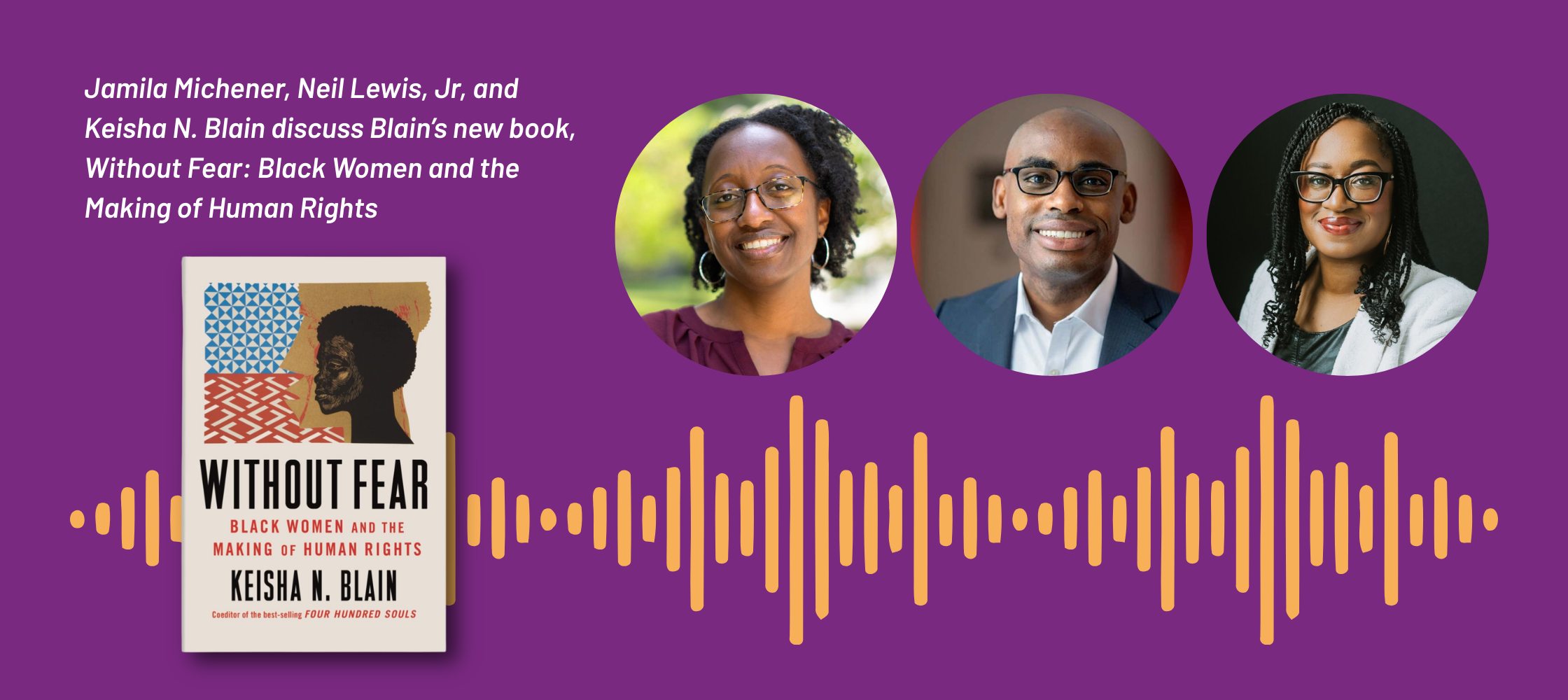
by Keisha N. Blain, Jamila Michener & Neil Lewis, Jr.
Audio Transcript
JAMILA MICHENER: Hello listeners. Welcome to the Futures Forum. I’m Jamila Michener, Director of the Center for Racial Justice and Equitable Futures, and professor of Government and Public Policy at Cornell University.
NEIL LEWIS, JR: And I’m Neil Lewis, Jr., Associate Director of the Center, and associate professor of Communication and Public Policy at Cornell.
JAMILA: We launched the Futures Forum in late January of this year. It’s a multimodal venue. So far, we’ve had traditional written blogs, a creative post featuring original art, but this is our first podcast on the Futures Forum, and we’re honored to have the inspired and the inspiring Keisha Blain here with us for the occasion.
KEISHA N. BLAIN: Thank you for having me.
JAMILA: Dr. Blain is one of the most influential and important historians of our generation. She is a professor at Brown University, a Guggenheim Fellow, a Carnegie Fellow, and too much more for me to list here. You should look her up for sure, and you’ll be as astonished and impressed as I was when I read her background. Dr. Blain is author of numerous books, but today we’re here to discuss her latest book, Without Fear: Black Women and the Making of Human Rights.
I’m particularly excited to have Dr. Blain with us here at this moment in time. History has always been contested terrain, but the struggle feels more urgent and, arguably, more existential now than it has ever been. One reason for such fierce contestation over historical narratives is that history holds power. The power to model possibilities, teach liberatory lessons, cultivate radical imagination, and so much more.
Alice Walker said that “the most common way that people give up their power is by thinking they don’t have any.” Keisha Blain illuminates the breadth and scope of Black women throughout history, exercising power against all odds, with both domestic and global intention. The path that she lights is more pivotal now than ever, and we’re excited for this chance to be in conversation with her. Let’s jump in!
NEIL: Keisha, it is so great to have you with us. I learned so much from reading this book. You know, we’ve had many conversations with others in our community who’ve read this book, and so, you know, I’m really excited to have a chance to talk with you more about it.
One thing I kept thinking about as I read the book was your journey in writing it. That’s something I always think about when I’m reading books. And so, can you tell us a bit more about that, more about you beyond the bios that we’ve read online. What motivated you to write this book?
KEISHA: Well thank you again for having me. It’s wonderful to be here. I decided to start writing this book as I was finishing up my previous book, which was a biography on civil rights activist Fannie Lou Hamer. And at the time I was struck by a particular quote from Hamer. She started saying it toward the late 1960s, and, I am paraphrasing, but it was something along the lines of, “I’ve passed equal rights, I’m now fighting for human rights.” Other times she would say it differently to replace the phrase equal rights with civil rights. And I was struck by this statement because I think it really helped to explain how there was, in many ways, what we can think of as an ideological shift among many activists of the period who started thinking beyond citizenship. And as much as they were very invested in expanding Black political rights and particularly thinking about the importance of Black people being represented as and recognized, rather, as part of the national polity, they were also grappling with larger issues, and particularly thinking about rights that extended to all people on the basis of their humanity. And so the phrase, shifting from equal rights to human rights, was an important one for Hamer and one that I grappled with. I knew that there was more to tell on this matter. I knew that there was more that I could say on the matter, but I also needed to confine myself to the task at hand, which was to finish this book on Fannie Lou Hamer and her ideas, and particularly how her ideas are relevant to the current moment.
And so I decided that it would be important to take a closer look, to grapple with Black women’s ideas around human rights, their activism particularly, and to branch out far beyond Fannie Lou Hamer. I wanted to get a better sense of what human rights history might look like if we center Black women. And in many ways, the story that I tell in Without Fear I do think comes out of my own personal story, too. I think a lot of people do not know that I’m actually from the Caribbean. I was born in Grenada. But I grew up mostly in Brooklyn, New York, and I mention that because I think that particular personal experience has helped me particularly around the way that I think of the world. I always grapple with the local: I think about local politics, I think about relationships among local residents, but I also grapple with national concerns as I grapple with global concerns. And so I think about just the importance of movement across national borders. I think about the importance of a transnational kind of framing when we think about US history or African American history in particular, and that has guided my work. And I’ve also been deeply invested in centering Black women’s ideas, and paying attention to their lives, and drawing connections to the present. That’s the other aspect of my work that I think is important. And so Without Fear, I think, brings together all of these concerns, and it pushed me in new directions, too. I ended up starting the book really in a much earlier period of history than I generally study. I primarily focus on the twentieth century, but I knew I needed to step back further. I needed to grapple with the revolutionary period if I was going to actually tell the long history of human rights and be able to talk about Black women’s contributions. And so, this is truly a book that I think builds on many years of research and thinking about these topics, and I’m just thrilled to have a chance to discuss it today.
NEIL: Yeah, that’s really fascinating, and I love that longer arc that you took in the book, but also hearing more about your personal arc and how that shaped how you approached the book.
JAMILA: And I’m struck by the resonance in your personal arc as well. First of all, I’m laughing at the fact that all three of us are from a Caribbean background, right?
NEIL: Yes.
JAMILA: My parents are from the Caribbean, Neil’s, and yours. And in fact, last week when we were having one of our reading circles and we were talking with folks about the book, one of the things we had— a part of the conversation we talked about what was meaningful to each person in the room, and one of the things I said is coming from a family that— my parents were not born in the US. It was never the case that I thought everything oriented around this one place, right? I always thought about the world from a sort of global perspective. So it was really nice to see that reflected in the text and to hear you reflect back to us that that’s part of your personal journey.
Well, let’s talk a bit about the title. I love the title as someone who is pretty notoriously terrible at picking titles. It’s— I can’t ever pick titles that I like for my work, and I also often don’t like other people’s titles. So as a title critic, you found one that I enjoy, in part because it’s aspirational. At this moment, fear feels like the easiest thing to give into. And this idea of “without fear”—it just grabbed hold of me, and I’d love to hear a little bit from you about how you came to that title.
KEISHA: Yes, well I will say I’m not great at titles, either. And in fact, I will admit that the decision about the title of the book was perhaps a decision that came at the eleventh hour. In fact, I was going back and forth with the team I was working with at Norton, I was talking to not only my editor but also members of the marketing team, and they said, “You know, you really need to make a decision here.” And of course, I was up against a deadline, I had already turned in the book, we had discussed multiple different titles. I had a placeholder, you know, throughout the introduction: “title here once we figure this out,” which was hilarious. And my editor said to me, “You know, just sit with the book for a few days. Just sit with it and see what jumps out at you, and maybe reach back out, give us a couple of phrases that you think truly capture the essence of what you’re trying to say here.” And that was good advice. I just spent several days reading through the book over and over again, and I was jotting down phrases that stood out to me that I thought helped to explain the arc of the manuscript, but even more so the overall vision and the argument that I was trying to make. And Without Fear was one of about three or four options that I jotted down. I then reached out to the team I was working with and said, “Okay, here are a couple, what do you think?” And I said, you know, “I’m leaning toward Without Fear,” and they all said, “That’s it.”
And as soon as they agreed, I then quickly revised my introduction to complete it, to put it in there. And of course one of the reasons why I could focus on it is because I had used the quote. In the book, I talk about Mary McLeod Bethune speaking to a group of Black women in 1944, and she’s telling them that, essentially, the work that we’re doing is important, and we have to continue doing that work transnationally, and we have to do it without fear and hesitancy. And so, it really did not only capture the period of the 1940s, which of course we can think about the context of World War II, we can think about all of the reasons why Black women would have been fearful. Especially those who were involved in human rights advocacy at the time. And it resonated so well with this current moment. As you can imagine, I certainly did not predict that my book would come out in a year in which we would experience so much turmoil, you know, certainly at the national level, but even at the global level. I certainly could not have predicted, for example, the outcome of the presidential election. I think many people were surprised as I were just a couple of months ago. And in the end, it just worked out so well that the book, I think, spoke to the past, absolutely spoke to the present, and gestured to the future. And I think that’s truly remarkable. And I’m also particularly grateful that the title ended up coming out of a quote from someone like Mary McLeod Bethune who’s so vital to the story that I tell and into, of course, to human rights in general. So I admit that it was a struggle to get there. I’m always going back and forth with titles, but this really worked out, and I’m truly thankful that it did because, as you point out, people who even pick up the book often tell me—before they even read the book—that they’re inspired by that title.
NEIL: Yeah, and it’s really interesting to hear that behind-the-scenes story, because when I got to that quote in the book, I had this moment of resonance, where like, “Well, of course this is the title!” But it’s interesting to hear that, well, you know, as an author, you go through these struggles in trying to figure out what is the essence here that I’m trying to convey, even though as the reader you don’t get to see that whole process, so it’s great to hear that story.
KEISHA: And I went through that, too. As we were talking, it makes me think about my first book, which is Set the World on Fire, and a lot of people say, “Oh I love that title!” And I have to give credit where credit is due. So, my friend Ibram Kendi—who’s really great with titles, as it turns out—I was going back and forth with him, and I was like, “I can’t decide—
NEIL: He’s had a few good ones—
KEISHA: Yes, I think you know who he is.
JAMILA: Yeah.
KEISHA: And I was complaining to him at the time, I said, “I can’t figure this out, and everyone’s frustrated with me because I need to come up with a title.” And he was like, “Alright, let me take a look. Let me take a look.” And he sat down and went through the manuscript, and he emailed me and said, “It’s so obvious. It’s Set the World on Fire.” And I’m like, “Well, of course!” And which of course came from a poem that I referenced in the book, so yeah, it worked out so perfectly. So some people are truly gifted when it comes to titles, and others are not.
NEIL: Yeah. So, you know, one of the things that’s been exciting for us at the Center is when we selected you as our speaker and were excited about your book coming out, we decided to do some community reads around the book, right? So we were able to organize these reading groups with local members of our community, with students and faculty on campus and so forth, and had these really rich discussions about the book leading up to your talk later today. You know, along the way there were a number of questions that came up, but one that kept coming up over and over again in conversations was the question about your overall approach. For those who haven’t read the book yet, one thing you’ll notice is it covers a lot of ground. You introduce us to so many people in the book. And it was inspiring to read about all of the amazing Black women who were leading the push for human rights across so many fronts, but frankly it was also overwhelming at times to keep track of all the different figures that you wrote about. And so, you know, the fact that you wrote in that way ended up raising some interesting questions among our reading group participants. Some comments from the fact that there’s some historians who will pick a few figures and go deep on them. But you took a different approach that our participants noticed. And so can you say a bit more about that choice to cover such a broad range of people?
KEISHA: Absolutely, and I will say it was intentional. One of the things that I would emphasize is when I’m working on projects, I really do think of each book as contributing something unique. And something that very much connects to other things that I’ve written, but also move in different directions. I mentioned that the previous book I had written was a biography. So I knew from the outset that I didn’t want to write another biography for this particular book, though I hope to write biographies into the future. I certainly love writing biographies. And this book, it was important for me to weave in as many Black women as possible, intentionally, because I knew that if I focused on just a few women—the historian in me had me really thinking about how people would interpret the text, how they would read it, and I knew immediately that one of the main critiques would be, “Well, she focused on a few women and so these women are exceptional. They don’t represent, necessarily, the whole,” right? “They don’t represent a broad spectrum, they don’t represent a pattern.”
And so I thought about that critique, and I knew one way to counter it would be to demonstrate, even if briefly, that in fact, it’s not that a few women were thinking about human rights, actually, but it was that so many women were thinking about human rights. And that they were doing so in different locales across the United States, and they were doing so despite differences in political perspectives. So intentionally I talk about Black women on the Communist left, because I didn’t want to send the message that, well, human rights history is all about Black women involved in the NAACP. They are in the book, but not exclusively. I wanted to also show that when we talk about human rights history and Black women’s contributions, that it wasn’t just a story about Black middle class and elite women. So I worked really hard to be able to capture Black working class, Black working poor women. Which is so hard to do in general, but also hard to do, I think, for this topic, given limitations of sources, and just a range of factors. But I knew that if I packed the book that I would ultimately help readers capture what I have been saying from the very beginning: that Black women have always been thinking about human rights, and they’ve been doing so long before the term was popular in public discourse. And so yes, it was intentional to weave in so much.
I’ll also say, too, as I was writing the book I was thinking about future researchers, and that’s something that I think a lot of people might be surprised to know, but it is in fact something I thought deeply about. Perhaps it just comes out of my own experience. I work with a lot of grad students, and I’m always grappling with how do we help students come up with original ideas for dissertations. I know that one of the reasons that I was able to even write a dissertation was because of someone referencing a woman in passing, and that led me on the path to find more information, and now I’ve published a book on this person. And while writing a book on that person, I came across other individuals who now show up in Without Fear, right? So part of what I did was I intentionally mentioned certain people, even if I did so briefly, because I saw myself as really offering, you might think, as if I was offering breadcrumbs to say, “Listen, follow the lead,” right? And see where this takes you. And I tried to pack in as much as I could, knowing full well that I couldn’t do justice to every single woman, that I simply didn’t have as much. There are times where I have a lot of detail. What’s also interesting to admit is that even though the book covers so many women, I also left out a lot of women.
JAMILA: Wow.
KEISHA: And I think readers, you know, would be surprised when they realize that I don’t talk about Fannie Lou Hamer. I’ve been asked about this, and my response is, “Well, I wrote a biography, so, you know, give me a pass on that!” But that’s important to grapple with because it means that even though it seems like I’ve covered so much, there’s still so much to cover. And that is really the point of what I’m making, is that Black women have been central to this history yet invisible. I’m grappling with that point, I’m helping readers understand—showing, hopefully effectively, not only telling—but showing what I mean by Black women as shaping human rights history.
NEIL: That breadcrumb idea is also— I’m glad you named that, because, you know, my copy, I have a few notes in there: “I need to read more about this person.“ And so—
KEISHA: Yes, yes.
NEIL: Yeah, I think you’ll definitely plant seeds for, not just for other students in the future, but many of us reading it for a variety of other reasons. So, one quick follow up, I guess, on the breadth of people you covered: did you have a favorite?
KEISHA: Yes, I did! Which is, of course, difficult because there’s so many people that I found fascinating, but one woman in particular, who I have been thinking a lot of and may write some more about her in the future, is Margaret Cartwright. I talk about her in the book. I will say that I first learned about Margaret Cartwright sometime around, I think, 2018. I had just published my first book, Set the World on Fire, and then someone reached out to me from Tulane, from the Amistad Research Center, and said, you know, “We have this new collection, we’d love to talk to you about it, and we’re just getting it organized. We know you’d be interested: it’s about internationalism,” and as soon as they said that, I thought, okay, let me take a look. And I had not heard of her before, so I thought that was interesting. I was surprised to find out that she was a columnist for the Pittsburgh Courier, that she wrote for New York Amsterdam News, that she traveled extensively, she was involved in the UN, and just a remarkable figure. And that led me on a path to want to know more about her, but also I, at the time, decided, well I have other things to do but I want to get back to this person at some point.
And I’m glad that I was able to get back to Maragret Cartwright because one of the reasons that I really do like talking about her and thinking about her is that she reminds me of myself. And why? Well, because she was a professor, so she was a professor in the 1950s and ’60s—she taught at Hunter College in New York City—and she traveled extensively for research but also just to be an observer, a listener, someone who took careful notes. She found herself in places where, in the larger history, we don’t tend to talk about Black women as being even present. So what do I mean? We find Margaret Cartwright traveling all the way to Indonesia in 1955 to attend the Bandung Conference. That’s simply not an aspect of the history that we tend to focus on. She’s in Accra, Ghana, in 1958 with Kwame Nkrumah and so many others, listening, taking notes, and then going back and writing these very powerful columns that published in multiple venues and circulated widely in Black communities, and it was her way of ensuring that Black Americans would be fully informed about developments taking place across the globe. It was truly a remarkable act to utilize one’s writings in particular. And of course there are connections to Ida B. Wells as a journalist, and there’s so many things. But I was fascinated with her. And also one of the reasons I connect with her is because she received a bit of critique, sometimes publicly, oftentimes in private, where people felt like she did too much. She did a whole lot, and I could relate, I hear that all the time. And she was sometimes frustrated with the critique because she wanted people to understand that, even though she did a lot, she wasn’t just taking on projects to do things. It wasn’t just about being busy. It was about following her commitments, and that particular aspect of her story deeply resonates with me. Which is why I do so much, because I have so many commitments of things that matter to me. It’s not about just being busy, it is about doing the work that I do think is important to do, and trying to balance so many different things. And so we see that come through her life. So I really love writing and talking about her, because she reminds me of myself in many ways.
NEIL: Yeah, that’s really helpful.
JAMILA: It’s really great to hear some of the kind of thinking and the logic, just the sentiment behind the different decisions you made with the book. I think because I spent so much time with the book, it just gives it this depth and richness. But one of the things that I thought about and that came up in our reading group, was this question of voice. I was struck by how it didn’t feel often like I could discern your voice in the book. Instead, you really, as much as possible, I sensed, foregrounded the voices of these women, and I wondered whether that was intentional, and if so, what the thinking around that was.
KEISHA: Yes, so it was intentional. I mentioned earlier that when I’m writing books, I’m, at the very beginning, I spend a lot of time thinking about who I’m writing for. What’s a particular genre that I want to engage, or genres plural? What am I trying to accomplish? And the answer is not necessarily the same for each book. I think what’s interesting about the way that I write and just my whole career, I’m speaking often to multiple audiences, which means that sometimes a book project comes to fruition because I’m thinking about a particular debate among scholars. And other times, a book project comes to fruition because I’m thinking about the contemporary moment, the political climate, and how I might respond to it. And that’s true for my book on Fannie Lou Hamer.
So one of the things that I think those who read my work will notice is that the Hamer book is just very different than this book. In the Hamer book I talk about myself, I talk about my journey, I talk about what Hamer means to me as an intellectual, as a person. And I feel like I was certainly opening up a window into my life with the Hamer book, and I was being very clear about where I stood on a number of issues, and so even if I was grappling with her life, I also wanted to make some very clear statements about what I thought about state-sanctioned violence, and grappling with that, as one example. And so there’s a way in which some people have argued that the Hamer book felt like op-eds weaved into this larger narrative, and that would be true! This book was different. I think this book, I absolutely wanted to center these women’s ideas and I’ll say, too, that I’m interested in different kinds of history, but I’m particularly drawn to intellectual history, which is to say that I’m deeply invested in grappling with ideas and ideologies. I’m interested in how people theorize, how they conceptualize the world in which they live, how they devise strategies to respond to social issues and concerns. I do pay attention to what people do, but I want to be clear about: What are the ideas that undergird their actions? How do we— what leads someone to make a decision? What compels them to join a particular group or a movement?
And so these are the kinds of questions that I’m asking, and to be able to center these women as thinkers I needed their voice to be at the forefront, not mine. And so that was certainly difficult. It meant, at times, trying to balance when I would emphasize my interpretation of what these women had to say. Even my critiques: I oftentimes struggled with when I would insert my voice to say, wait a minute, right? Look at how this woman thinks she’s talking about freedom, but actually she’s saying some things that’s contradictory, right? And as a scholar and writer, I have to offer critical analysis. But part of what I needed to do was figure out a strategy where I could do that without dominating. And so I hope I’ve done that. It is definitely— it’s difficult, as you can imagine. I had to write multiple drafts of chapters, and I had different people read my work, which is important. I shared drafts with many scholars who I trust, and I certainly knew they would give me feedback. But I also shared chapters with people who are not scholars, which was a different, an interesting, exercise of people saying to me, you know, “I don’t get any of this. Get to the point. What did you actually mean?” And that was helpful! Painful, but helpful, as I was revising. So it was a balance, and not easy to do, but I certainly hope that various audiences will find something meaningful in the book.
JAMILA: Oh yeah. I think your hard work and your thoughtfulness—
NEIL: Yeah.
JAMILA: —really come through. I mean, it’s why we’re even asking the question, because you laid the foundation for really pushing your reader to think about: Who am I hearing? Who’s voice is shining through?
NEIL: Yeah.
KEISHA: Thank you.
NEIL: It’s so hard to decide on which questions to ask—there’s so many questions! But one other one that I’ve been thinking about, that maybe is a good question to sort of wrap with is: in this book, so you’re a historian, this book covers a lot of history. And in this history, though, you know, there’s this covering of stories of progress, but also backlash that these women faced. We in the Center, and the groups we organized, we read this book in the beginning of 2026 when a lot was happening—a lot is still happening, to put it lightly. And so I’m just wondering what lessons from your research on the past you think are sort of most relevant for thinking about the times we’re living in now.
KEISHA: Well, I think it’s important for readers to understand that when it comes to the past—and I think this is certainly relevant as we grapple with developments of the present and we think about the future—the road to progress is not a smooth path. And to your question, it absolutely is not linear. In fact, it is what I can best describe as a process of ebbs and flows. It’s also, in so many ways, a tug of war. What we see are moments of progress, certainly, and a lot of backlash. And moments where people feel like everything they have accomplished might be lost. And then they have to fight for it again. As I was writing the epilogue, that was probably the most difficult moment for me because I wanted to both reflect on the good things that have happened—I wanted to give a sense that in fact, well, when we get to the twenty-first century, it’s not exactly 1830s when Maria Stewart is speaking in Boston. But I also needed readers to understand that, well, it’s not the same, but let’s pay attention: we’re still dealing with some of the challenges that Maria Stewart responded to in the 1830s. So what does that tell us? That tells us the fight is ongoing. It also tells us that even when we work really hard to accomplish certain things, and particularly around laws and policies, the next fight is to protect them. And so human rights are important, but even as we grapple with this, we have to know that human rights are not permanent, which is to say that we have to keep fighting for them, and we have to protect them. We will feel as if we are doing that again and again and again, and that’s what you see happening in the book. That’s not the most hopeful message.
At the same time, it helps, I think, everyone to make sense of the moment we’re in. And if you look at the history and you pay attention to what’s happening across the nation, across the globe, you won’t necessarily go into full despair. You’ll actually say, well, wait a minute, this is part of the process, right? And so it’s not so much that we have to put up our hands and say, oh, you know, all of our work is in vain. No! It’s that, okay, now we have another kind of work to do as we move ahead. So yes, we celebrated the Voting Rights Act of 1965, and then we lived to see protections stripped away—we saw that in the Shelby Case as an example—and since then we’re seeing constant attacks. Does that mean we give up? No, it means now we have to continue fighting for voting rights and protection. So, it is very much a reminder that history is messy, which means the present will be messy, and the future might be messy. But we can’t give up simply because it doesn’t look as if we’re making progress. What exactly does progress look like, right? And that’s a question. And the book shows that it is far more complex than I think many people realize.
NEIL: For me, it was hopeful in a way. I mean, I think your reminder here is we can’t get complacent.
KEISHA: Right.
NEIL: And that is an important reminder, that just because rights were won doesn’t mean they’re permanent. I like that. But as I read it and was thinking about the times, right, and was like, these times feel very difficult, but then also, there have been worse. People worked through some much worse things and made progress. Some of that got pulled back at times, but again, keeping the work going is what’s really important, and so that was one of the lessons that I took away—and yeah, this reminder and this conversation about not being complacent and continuing the fight, I think, is important.
JAMILA: That is a really inspiring note to end on, Keisha. And even though you don’t give us a happy ending that is all tied up in a bow and that can make us feel warm and fuzzy inside, you give us something so much more valuable than that, which is the power of knowledge about what really happened in the world and who some of the hidden players who we often don’t see played a vital role in making it happen. I always tell my kids, you know, you have to have the proper expectations. If you expect that I’m going to give you a life of luxury, you will be disappointed. But if you expect my love, you’ll have it. Right? And so that’s a real gift I think we can bring into this moment moving forward. And it’s one that inspires, right? That we have to keep fighting, and that we can’t take anything for granted. Not our human rights and freedoms and not the vision of the world and the future that we want to see come into fruition. So, thank you for this. I’m really excited to see all that this is going to produce in the world as it continues to flow through communities and media and classrooms and all the places that I know the book has already gone and will continue to go.
KEISHA: Thank you so much.
This podcast was recorded at Cornell University, and produced by Bertrand Odom-Reed, Multimedia Producer Consultant.
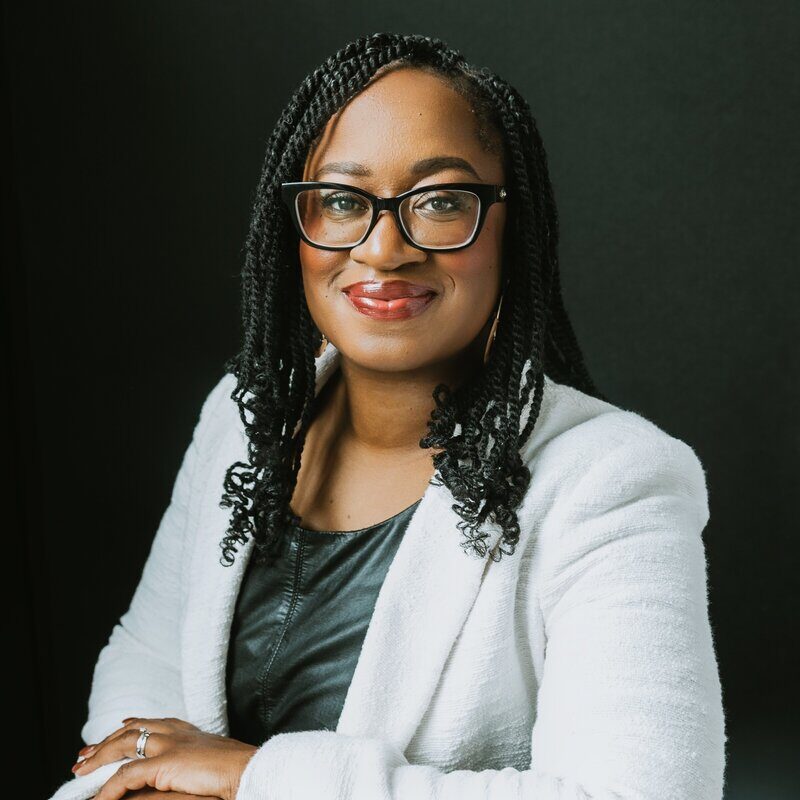
Keisha N. Blain
Keisha N. Blain, Professor of Africana Studies and History at Brown University, is the author of Without Fear: Black Women and the Making of Human Rights.
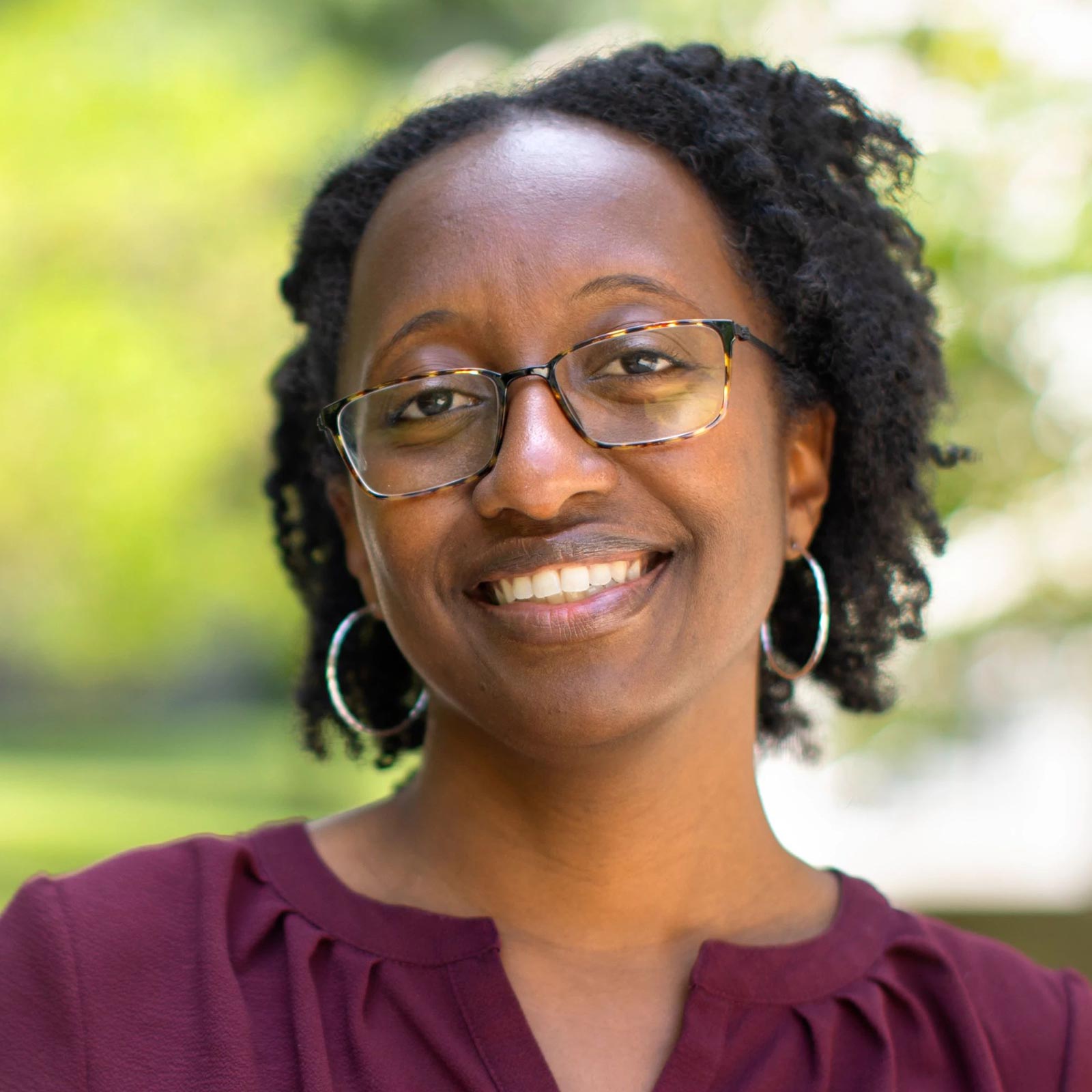
Jamila Michener
Jamila Michener, Professor of Government and Public Policy, is the inaugural director of the Center for Racial Justice and Equitable Futures.

Neil Lewis Jr.
Neil Lewis Jr, Associate Professor of Communication, Medicine, and Public Policy, is the inaugural associate director of the Center for Racial Justice and Equitable Futures.