Our Programs
We bring together researchers, organizations, and communities to co-develop knowledge that equips ordinary people to forge paths toward a more just world.
The Center for Racial Justice and Equitable Futures bridges research and action to advance positive change.
Our position within a research university allows us to thoughtfully cultivate communities of learning to spearhead and conduct innovative research that expands understanding of race, racism, and related inequalities.
Racial Justice Fellows Program
 The Racial Justice Fellows Program creates a pathway for Cornell students to be directly involved in work that enriches the campus community and beyond, with the aim of advancing systemic change. The program cultivates a generation of leaders who can help build a more just society. A new cohort of fellows will be selected each spring to begin the following fall.
The 2025–2026 cohort of Racial Justice Student Fellows is a group of nine graduate students and three undergraduate students whose work reflects a deep commitment to advancing racial equity and social transformation through research, creativity, and community engagement.
Racial Justice Impact Grants
 Racial Justice Impact Grants support transformative research and action by facilitating bold collaboration between researchers and community partners. Faculty from all disciplines and fields are invited to propose and develop high-impact collaborations that build knowledge and catalyze action to advance racial justice. For more details, contact equitable.futures@cornell.edu.
Spring 2025 Impact Grant Awardees
Lead Researcher: Angela Odoms-Young, Nancy Schlegel Meinig Professor of Maternal and Child Nutrition
Improving Dietary Behaviors and Addressing Food Insecurity in Youth and Young Adults (16–21) Living with Sickle Cell (SDC)
Lead Researcher: Monica Cornejo, Assistant Professor, Department of Communication
A Longitudinal Survey Exploring Formerly Detained Migrants’ Stressors, Risk, & Resilience
Postdoctoral Fellows Program
 The Racial Justice Postdoctoral Fellowship Program will deepen communities of learning at Cornell and enrich the network of scholars doing research and taking action to create more just and equitable futures.
Faculty Fellows Program
Faculty fellows at the Center for Racial Justice and Equitable Futures will develop and lead a project connected to their own research, teaching, and/or engagement during their 10-month fellowship term.
Faculty applicants are encouraged to think creatively and broadly about the projects they develop for their fellowship. Faculty can use this as an opportunity to pursue research that they otherwise might be unable to take on, design community engagement initiatives, organize seminars or conferences, facilitate writing groups, create student learning opportunities, and more.
2026 Faculty Fellows
Alexander Livingston
 Alexander Livingston is an Associate Professor in the Department of Government, and affiliated faculty in the American Studies and Religious Studies programs. His primary areas of research are democratic theory, social movements, religion and politics, and the history of twentieth-century political thought. He is the founding co-director of Cornell’s Democracy Scholars Program, a civic humanities summer institute opening pathways to higher education for rural high school students, and a former director of the Society for the Humanities.
Livingston’s fellowship project at the Center, Tough Love: The Prophetic Politics of Martin Luther King, Jr., reexamines King as an original political thinker by placing the religious foundations of his thought at the center of his public philosophy. Resituating King’s writings on civil disobedience, economic justice, and constitutional struggle within the contexts of midcentury political theology and the practices of the Southern Black church, the book aims to unsettle the secular assumptions of contemporary political theory and highlight the enduring significance of African American religious thought for contemporary debates about freedom, equality, and dissent.
Amelia Moore
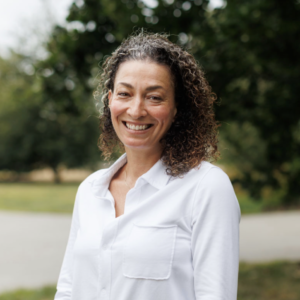 Dr. Amelia Moore is an environmental anthropologist and Associate Professor of Environmental Justice, Law, and Policy in the Natural Resources and Environment (NRE) Section of the new Ashley School of Global Development and the Environment in Cornell’s College of Agriculture and Life Sciences (CALS). Dr. Moore’s research explores island and coastal politics, the social effects of transnational environmental science and technology, and the inequities exacerbated by major global environmental changes like climate change, sea level rise, and biodiversity loss. She attempts to rigorously center equity and justice praxis in her research, teaching, and service within interdisciplinary STEM programs, which has meant working with a critical mass of experienced scholars to build a cohesive vision, committed leadership, and structural support for transformative program development.
As a Faculty Fellow of the Center for Racial Justice and Equitable Futures, Dr. Moore will contribute to the mission to “bring together people, knowledge, and action to forge paths to a transformed future” and to further the goal of “cultivating a community of learning” by planning and convening the Just Ocean and Coastal Futures Conference for the fall of 2026. This event will bring together future-oriented scholars who integrate racial justice work with anti-racist, de- and anti-colonial practices, and other reparative frameworks into coastal and ocean studies. The purpose of the conference is to share and produce knowledge while imagining, designing, and supporting strategic action.
Over multiple days of individual presentations, invited keynotes, roundtable discussions, workshop sessions, and communal events, participants will acknowledge, identify, and challenge pernicious ocean and coastal inequities including past and present events and structural processes at local, regional, and global scales. This will be an intimate gathering of professional scholars and graduate students from around the US, working domestically and internationally, committed to catalyzing just futures in coastal and ocean studies via knowledge and practice sharing, networking, and solidarity building. Dr. Moore hopes this event will help to reaffirm commitments to changing the culture of ocean and coastal research and policy in a time of fear and retrenchment.
Danny Parker
 Dr. Danny Parker is an Assistant Professor in the Department of Communication at Cornell University. Her research examines the role communication information environments play in the reproduction of poverty and the development of political identity. In particular, she studies how structural conditions—from carceral state economics to media coverage of poverty—undermine equal access to democratic institutions and weaken belief in democracy among poor communities.
With support from the Center for Racial Justice and Equitable Futures, Dr. Parker is launching the Community Voice Project, a multi-year, multi-city research program examining how structural conditions shape political beliefs and behaviors in low-income communities across different configurations of regional governance, community infrastructure, news ecologies, and demographic contexts. The project focuses especially on participants’ experiences with the criminal justice system, public assistance, access to medical care, environmental safety, and reliable information.
The project meets people where they are, deploying ethically trained research teams to conduct field surveys and documentary interviews in structurally disadvantaged communities across the United States. The research captures the political voice of citizens often excluded from public opinion research to ensure that perspectives frequently missing from conventional accounts of American democracy are heard, documented, and incorporated into contemporary political communication research. These accounts are then paired with administrative and GIS data to produce a detailed portrait of participants’ civic lives. Central to the project’s model is building long-term relationships with non-profit community partners to strengthen institutional trust and support Cornell’s land grant mission. This is accomplished through listening, providing material and logistical support, and collecting requested data specific to their missions so they can better serve their communities.
Isabel María Perera
 Isabel María Perera is an Assistant Professor of Government. Her research examines how politics shape the social policies, labor markets, and overall economies of post-industrial societies, focusing on the United States and Western Europe. Her first book, The Welfare Workforce: Why Mental Health Care Varies Across Affluent Democracies (Cambridge Studies in Comparative Politics Series), pointed to the political role of public sector trade unions in shaping mental health and other social services. Other work has appeared in World Politics, Governance, Politics & Society, as well as several health and medical journals, such as the Lancet Psychiatry and the American Journal of Public Health.
As a Center for Racial Justice and Equitable Futures Faculty Fellow, she will develop her next major project, Diversity and Distribution: Race, Immigration, and the Welfare State. The project systematically interrogates the popular claim that racially diverse societies cannot develop generous social benefits, hypothesizing that demography is not destiny. During her fellowship period, she will develop a new graduate seminar on this subject. Her broader aim is to learn from and foster scholarship on the relationship between political economy and racial equity.
Jocelyn Poe
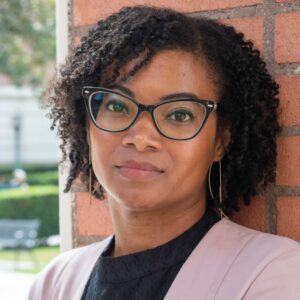 Jocelyn Poe, Ph.D., AICP is an Assistant Professor in the Department of City and Regional Planning at Cornell University. Her research centers on communal trauma, spatial justice, and the development of reparative planning practices that aim to foster more equitable futures. Dr. Poe is the Director of the Reparative Praxis Lab and the founder and principal of SaHA Planning Studio, LLC, where she integrates theory and practice to advance healing-centered planning strategies. She holds a Ph.D. in Urban Planning and Development from the University of Southern California, a Master of Community Planning from Auburn University, and a Bachelor of Architecture from Tuskegee University. Her work has been recognized through fellowships such as the Health Policy Research Scholar Fellowship from the Robert Wood Johnson Foundation and the Spatial Futures Fellowship from PolicyLink.
As both Global South and Deep South leaders turn toward reparations to envision a future where economic development can heal the land and its people, there are opportunities to integrate reparative theories, methodologies, and strategies from across the African diaspora. This project contributes to building a reparative praxis framework by exploring how a collaborative knowledge exchange can advance reparatory justice movements across these vastly different yet intersectional geographies. To explore this question, we engage an innovative method used in reparative spaces across the African continent: Indaba. This term originates from the Zulu language and describes a traditional gathering in which discourse and decision-making happen through diverse voices in public space. The goal is to expand reparatory knowledge, support policy, and programmatic implementation on the ground, and advance robust research on just and equitable development.
Graduate Student Research Grants
Graduate Student Research Grants support transformative research by equipping students to pursue bold, justice-oriented scholarship that advances racial equity and social change. We invite graduate students from all disciplines and fields to apply. The Center for Racial Justice and Equitable Futures will provide resources to support innovative, creative, and compelling projects with the potential to build knowledge useful for advancing racial justice.
This year’s awardees represent a wide range of fields—from political theory and public health to digital technologies and historical inquiry—each contributing vital insight into structures of power, identity, and belonging.
2025–2026 Awarded Research Initiatives
- The State and Social Transformation in Indian Political Thought
- East African Asians and the Bungalow: Plantation Economies and Housing in the Late Colonial Period
- Affirmative Action and Career Consequences: Evidence from Brazil
- The Political Consequences of Prison Privatization
- The Unequal Consequences of Fertility Stalls
- Auditing ASR Bias in Parole Hearing Transcription Systems
- Black Power and the Coordinates of Political Desire in Trinidad and Tobago, 1955–1975
- Defining the American West: Black Women of the Western United States, 1850–1920
- Digital Care as Resistance: Creating Sociotechnical Networks to Resist Extractive Futures
- Housing and the Hidden Geography of Segregation: Uncovering Micro-Spatial Mechanisms of Ethnic Residential Sorting
- Sharing Stories in the Margins: Envisioning Justice and Health Equity Through Somali Canadian Community Salons
- Assailing Asylum: The Political Manufacturing of an Asylum Crisis in the United States
- Tracing Collection Histories in the Pineapple Family: From Herbaria to Genomes
- Speculation and the Social Life of Vacancy in Seattle’s Third Places
- The Politics of Feeling Unsafe: How Emotions Sustain Punitive Law Enforcement
- Fostering Health Equity: Enhancing Patient-Centered Shared Decision-Making with AI Systems for Older Men with Early-Stage Prostate Cancer
Student Internships
The Center for Racial Justice and Equitable Futures at Cornell University offers internships for undergraduate and graduate students. in 2026–2027, we are offering five positions that offer hands-on experience at the intersection of racial justice, community engagement, and institutional change, supporting the Center’s programs, research, communications, and operations.
Interns work 5–15 hours per week and play an active role in the day-to-day work of the Center. Internships are intended to be long-term opportunities to grow alongside the Center and contribute meaningfully to its mission.
Internships, 2026–2027
- Communications Intern
- Data Visualization Intern
- Events & Programming Intern
- Office & Operations Intern
- Visual Storytelling Intern
Rooted in Justice Program
The Rooted in Justice program is a core initiative of the Center for Racial Justice that supports community-driven efforts to challenge systemic racism and advance equity across local upstate New York institutions. The program advances Cornell’s land-grant mission by investing in grassroots leadership, fostering cross-sector collaboration, and amplifying the voices of those most impacted by racial injustice. Guided by the Community Advisory Board, this program is rooted in accountability, transparency, and deep community partnership. Together, we build the conditions for long-term, transformative change.
Thriving Futures Ambassador Program
The Thriving Futures Ambassador program offers Cornell graduate and undergraduate students who have previously served as racial justice student fellows an opportunity for continued contribution to the center’s mission of building just and equitable futures for all. Student Ambassadors help to create programming and build community across (and beyond) the university.