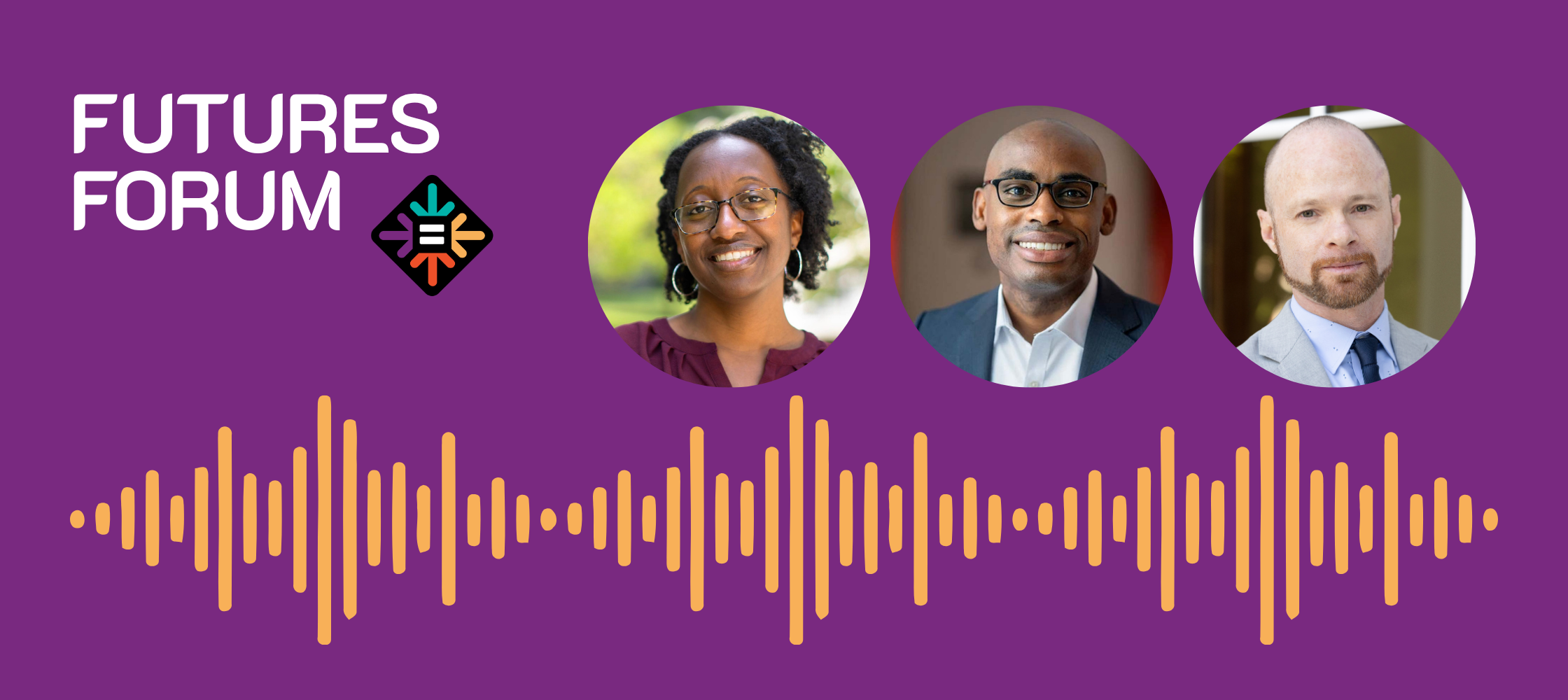
by Victor Ray, Jamila Michener & Neil Lewis, Jr.
Victor Ray’s decision to work as a public scholar, thinking and writing on issues of racial justice in the United States in a highly visible way, has not been an easy path but it has been an important one. On this episode of Futures Forum, we talk with Ray about his deep knowledge of the civil rights movement, the current turn toward resegregation in the United States, and why the backlash against DEI may have lasting ramifications well beyond the Trump administration.
Links to further reading from our discussion
- Throughout the conversation, we reference Victor Ray’s work on critical race theory, mental health services to veterans, anti-DEI initiatives as segregationist, and especially his theory of racialized organizations.
- In our brief discussion on “mesearch,” we consider Ray’s essay on the subject and Matthew Desmond’s Evicted, a seminal book on poverty and housing justice.
- On resegregation, we look at policies leading to job loss and the undoing of civil rights, what is happening in the U.S. military, and attacks on DEI.
- We apply lessons from the theory of racialized organizations to the Department of Justice, Equal Employment Opportunity, university DEI initiatives, and academic leadership and freedom.
- On resistance, we mention No Kings protests, coordinated resistance to ICE in Minneapolis, and what James Baldwin wrote in a 1962 essay for the New York Times: “Not everything that is faced can be changed, but nothing can be changed until it is faced.”
Audio transcript
Intro: This is the Futures Forum podcast, a production of the Center for Racial Justice and Equitable Futures at Cornell University. Find us online at equitablefutures.cornell.edu.
JAMILA MICHENER: Hello listeners. I’m Jamila Michener, director of the Center for Racial Justice and Equitable Futures, and professor of Government and Public Policy at Cornell University.
NEIL LEWIS, JR.: And I’m Neil Lewis, Jr., associate director at the Center, and associate professor of Communication and Public Policy at Cornell.
JAMILA: Welcome back to the Futures Forum podcast! Futures Forum is a multimodal space for collectively dreaming, imagining, and co-creating ideas. Since we started Futures Forum earlier this year, we’ve had rich and fruitful conversations with Keisha Blain and Marcia Easley. Those discussions have been largely, and importantly, focused on history. Today, we have Victor Ray on the podcast to talk with us about the acute challenges to racial justice that we face in the current moment. Welcome to the show, Victor.
VICTOR RAY: Hey! Thank you for having me, and I’m happy to be here with you two.
JAMILA: We’re really thrilled to have you. For anyone in our audience who isn’t familiar with Victor Ray—first of all, if you’re not familiar, you gotta read, you gotta get familiar, it’s worth your time! But let’s start with some context. Dr. Ray is the F. Wendell Miller Associate Professor in the Department of Sociology at the University of Iowa. He’s had fellowships in Governance Studies at The Brookings Institution, the Carr Center at the Kennedy School, and Harvard Business School. Most importantly for our purposes, Victor Ray is a leading voice on issues of racial justice in the United States. From his seminal book entitled On Critical Race Theory: Why It Matters & Why You Should Care to his widely cited and incredibly influential work on racialized organizations, he is perfectly poised to delve deep with us today.
Indeed, the corpus of Victor’s work is wide enough that Neil and I, when we were planning for this podcast, were like, “We could talk to Victor Ray about a million things! What do we really want to focus on?” We knew we were going to have to have some self-control and drill down. And we decided to focus our conversation on the backlash to DEI and, more generally, the fierce opposition to discourse around racism and racial inequity that we’ve seen intensify over the last few years.
I always observe that, though the Center for Racial Justice and Equitable Futures was first proposed in 2021—when many Americans still understood themselves to be in the midst of some sort of racial reckoning—it was not officially started, the Center, until 2024. So between the time it was proposed and the time it was started, the reckoning had given way to vitriolic backlash, and turning political tides made honest conversation about racism an anathema to many people. The whiplash was fast and swift. So what happened? And what does this mean? How do we continue to pursue racial justice in the face of all of this? I think that Victor Ray has all the answers, every single one. And even if he doesn’t, he certainly has a lot to help us think through these questions, so buckle up everyone!
NEIL: Victor, it’s so great to have you here. There’s so many things we can talk about, as Jamila mentioned. But maybe to get us started, we like to have our guests say a bit more—beyond the bio, beyond the official bios that we can read online—say a bit more about who they are and what motivates them. So beyond the bio that Jamila just shared with us, can you tell us a bit more about what brought you to the work that you do, and what motivates you to continue it, especially during these difficult times that we’re living through where it’s hard to be a scholar on race and racism more broadly, but to be a scholar who’s as public about these issues as you are.
VICTOR: Thank you for that question. So, what brought me to this work is my biography, right, my history. So I’m mixed-race, I’m light-skinned enough to pass. Most folks assume I’m white or white-presenting when I’m out in public. But from the earliest moments of my life, I watched, just like, really intense differential treatment for the darker-skinned folks, mostly men, who were raising me in my family. And so, you know, in my book on critical race theory, I open the book with being two years old at a parade in Pittsburgh and having the police called on my uncle because people thought he kidnapped me. And so that was the sort of repeated type of interaction I saw throughout my life, and which my darker-skinned brother who was treated differently than me in school or when we went into stores. The police were called on my dad for playing with me in the yard. So I saw these interactions multiple times over the course of my life and, to put it sort of non-scholarly, it pissed me off. It’s very upsetting to see people who loved me, who I loved, and who were doing everything right be treated just horribly in the broader society. So that’s the sort of personal biographical reason that I started doing this work.
The other reason was that, scholar-wise, I found it incredibly interesting. When I was a teenager, my dad and my grandfather encouraged me to read stuff like The Autobiography of Malcolm X and Roots and learn. They were like, “Although you can pass, you need to know this history.” And I got into it, right? And so, when I went to college—again I saw similar patterns in college. I started in community college in New York City right after 9/11, and it was like 90% minority, very—Borough of Manhattan Community College—very under-resourced community college. I ended up transferring from there to Vassar, which is, like, a little idyllic playground. And the difference in resources got me thinking about organizations and race and the difference in resources, and the way students were being trained by the community college to go into the workforce and at Vassar to really lead the workforce. It also started me thinking about race, and that’s also where I got introduced to critical race theory and the scholarship that really helped me explain my personal experiences but also the broader patterns of relations that I was seeing.
NEIL: Yeah, that’s really fascinating. You know, I knew some of the tidbits that you shared, but it’s really helpful to hear you weave all those experiences together, and how the lived reality of it all, from very early in life, and then connecting that to what you experienced in these different kinds of organizations, helped you develop this broader body of work that we now know you for, like the racialized nature of organizations in society, so thanks for sharing that.
VICTOR: Yeah, of course.
JAMILA: Yeah, and I appreciate your honesty about the personal dimensions of that. I mean, I’m a big proponent of “mesearch”. I know that people sometimes use that “mesearch” as a pejorative, and I think of it as the opposite, like we’re the best position to think about the important questions: to ask them, to answer them, to pursue them, when we have had some actual experience and connection to the kind of heart of those questions, right? I really love that. And I also just love to think about some of the things that are trite that we can say sometimes, like “race is a social construct,” right?
VICTOR: Right.
JAMILA: And then think about how experiences—”Oh, it’s not biological, right?”—and then think about how experiences can really shape that, right? That you can be someone who, phenotypically, people read as white—although I don’t think I ever would have read you as white—but even that! Even like how you’re read and by whom.
VICTOR: By whom, yeah.
JAMILA: Yeah, all of these things are embedded socially. Like, I will meet somebody sometimes, and I’m like, mm, I could see that that person could be read as white, but there’s something else there, you know? No, but just being able to have those experiences yourself of how you’re read, how family members are read, and what the implications of that are. It brings a notion like race is a social construct to life in a way that I think is hard for people to grasp outside of experiences like that.
VICTOR: Right. Yeah, for me, at the community college, I came across the idea of the social construction of reality, and I was actually, like, very much put off by that idea. I was like, “Wait a minute. If I step out of this window, I’m gonna fall. Physics is real! I don’t understand what you’re talking about in terms of the social construction of reality.” But then, as soon as we moved to the social construction of race, I was like, “Oh, now I get this.” Because of my lived experience, I understand that the way I’m read versus how my internal sense of identity versus a communal sense of identity are negotiated in interactions and negotiated, not once over the course of my life, but repeatedly. So yeah, I want to talk for a minute about the “mesearch” thing here, too. And I think, you know, it’s important for me to think about who gets labeled as doing “mesearch,” right?
JAMILA: Yep.
VICTOR: So one of things I try and do, and you know, I learned from critical race theory, is use those personal stories but try and connect them to broader patterns, right? So you don’t want to stop at, “The police were called on my father, and I think that’s what happens every time,” right? But you do want to say, “Look, this is how this connects to larger structures in society.” And I wanted to point to a book that I love and that I think is, like, brilliant scholarship, and that’s Matthew Desmond’s Evicted. And so, if you read Matthew Desmond’s Evicted, he’s like, “My family was evicted, and that’s what took me to this study.” But I have never seen his work called “mesearch,” although it very much is. And so I think there’s a way in which that idea gets racialized, and often gendered, in ways that discount the scholarship of marginalized folks that does not necessarily happen to folks at the top of the hierarchy.
JAMILA: Absolutely. I think that’s exactly the right point. I mean my inclination with things like that is to lean into them and not to fight them. Like, yeah, my experience is informing my research. That’s why my research is so good, you know?
VICTOR: I want to say one other thing about that. I think you’re right, and I also think that—ha. In one of the first articles I wrote, the reviewers—I talked about people of color; the article wasn’t about race, but I did mention the people’s race, right?—and one of the reviewers was like, “I don’t understand why you’re mentioning race if the analysis was based on mental health,” you know, the analysis was about mental health. And my response was, “Well, you know, people of color also have universal experiences,” right? And by erasing their race, folks are going to assume they’re white and that I’m talking about a universal experience. I am talking about a universal experience—but one that people of color also share.
JAMILA: I love these nuances in terms of how we think about research and how we position people of color and think about and position race in our research in really nuanced and critical ways. Thank you for that. And it’s also just good to get a sense of what makes you tick.
One of the things that really strikes me when I read your research and just observe, you know, your scholarly approach more generally is the boldness of it. I have felt for a long time that you say what the evidence and your theoretical scholarly insights lead you to say, even when it’s challenging. And in January 2025, you had a piece in the Emancipator—I remember really clearly, I can tell you where I was sitting down when I read it!
VICTOR: That’s flattering!
JAMILA: You argued there that, among many other things, that, “Whatever ‘making America great again’ truly means,” and then a little bit more, but at some point you say, “Segregation is essential to it.” Right? I remember stopping at that point to reflect on it. And it’s a framing that I think a lot of people found clarifying.
NEIL: Yeah, I’ll jump in here, too. I had a similar reaction to Jamila. We weren’t sitting together at the time, but we were all reading this piece in separate circles and having these kinds of reactions. And I remember seeing it and having sort of two thoughts: (1) Victor’s right about this, but (2) he’s going to get a lot of pushback for making this claim. And a lot of our interactions over the years have been online, on academic social media, and so I went to look, like, “How are people reacting to this piece?” And saw, yeah, the people who know about American history found it helpful, and there are a lot of other people who are quite pissed about that framing. And so I’m curious to hear about what that was like for you.
VICTOR: What—writing it, or the response? I mean, I guess I can just talk about the piece, and that—
JAMILA: Yeah, and break it down for our listeners who might be like, “Wait, what does segregation have to do with that?”
VICTOR: So, I was thinking here, on the second day of Trump’s second reign, he overturned a Johnson-era executive order that ensured federal contractors were not discriminated against, and this covered something like a fifth of the federal workforce—like it’s a really big portion of the workforce. And so that, coupled with many of the other anti-DEI legislation that they were trying to get through, or executive—legislation mostly at the state level, but then the executive orders that he was putting out, and I was like, these were the things, the literal mechanisms, that allowed an integrated United States following the civil rights movement, right? So compliance officers, anti-discrimination policy, anti-discrimination law led to an imperfect and deeply flawed integration into mainstream organization. And so if you’re getting rid of those, then you are slowly going to resegregate, right? And we’re already seeing some of that, right? I forget what the number is right now, but anywhere between 300,000–600,000 Black women have lost jobs since Trump’s second inauguration? If you’ve followed the news about [Pete] Hegseth and the military, which was one of the first institutions that desegregated in the United States, there’s a slow resegregation. He’s literally checking off individual people of color from being promoted to 1-star general level, right? So if you look at what’s happened in higher ed around turning back on the diversity policy and anti-DEI policy, all of these were things that, again, led to an imperfect and flawed integration, but nonetheless were substantive changes. So that was part of it. I think the second thing that I wanted to do in that article was, like, lots of folks don’t understand what segregation was. So—especially like the Jim Crow-style segregation that happened in the South. And so before I wrote the piece I had been talking about segregation, and one of the impetuses to the piece—I had been talking about segregation on social media—and there were these people who were like, “No, segregation meant total separation,” and I’m like, what are you talking about? Segregation, in some instances, meant separation of Black students and white students in schools, but the reason that we have pictures of segregated water fountains and segregated bus stations and segregated bathrooms is that they were the same building. It was a set of rituals that reinforced notions of superiority and inferiority in daily life, right? And what that did was, in both Black folks and white folks, reassert the social order. What I was trying to say in the piece is I don’t think the things that the Trump administration has done and that state legislatures are doing means that Black folks and white folks and Latinos and Asians aren’t going to share some physical spaces together. But what it is trying to do is reassert a certain kind of hierarchy in those physical spaces and, in some cases, make fewer of us allowed in the space in the first place, right? So I was trying to get across that segregation was a social system that sometimes called for full separation, but always reinforced notions of superiority and inferiority, right? It was a white supremacist institution.
And as far as pushback, I’d already been getting pushback for my posts before the article came out, and I think it was very similar to how you outlined it, you know? So there were some folks who were like, “What are you talking about?” There were other folks that were like, “This is a good way to think about this.” And I would also say, at a very similar time, there were a number of other people who wrote pieces arguing very similar things. So, Nikole Hannah-Jones wrote a piece on overturning sixty years of civil rights legislation in the New York Times Magazine. Adam Serwer wrote a piece called “The Great Resegregation” in the Atlantic. So there were a bunch of folks who think about this honing in on very similar arguments at the same time, and to me, that’s usually a sense, even if you’re not 100% right, that you’re on to something. That something is changing because folks are converging on this particular set of policies.
NEIL: Yeah, it’s definitely not a perspective that’s wild or out there. There’s convergent validity, if you will, when you’ve got multiple scholars who think about these things converging on the same point.
VICTOR: I wanted to say one other thing, that—I don’t think it made it into the piece. It could be sort of, like, my inability to express this clearly, so I’m going to try it here. And that is: one thing that I think scholars of the colorblind era and the New Racism, they talked about the way it sort of stigmatized open expressions of racism. But another thing that I think it did was it sort of disallowed us to call people segregationists. Because calling people segregationists made it me saying they’re a bad person rather than saying, “Here’s a set of policies that are going to create this particular given set of impacts,” right? And so I think part of the response is folks hearing this language and thinking, “Well, we defeated the segregationists,” right? “We won, that battle’s over, so why are you bringing up these people who died out in the 1960s and early ’70s?” And my point is, like, they didn’t die out. They might have gone underground, but they’ve been fighting that entire sixty years to reinstantiate some of those policies, and now they have the opportunity. Now they’re doing it.
NEIL: And building on that, it’s not just about particular people per se, which, you know, is not the point I really wanted to explore with you, because that piece made me think a lot about some of your other scholarly contributions, and one of the things I think about a lot with your work is the theory of racialized organizations that you’ve outlined, and so, where it’s not just about particularly bad actors being racist or being segregationists and so forth. And so maybe, can you tell us a bit more about what is that theory about, and can you then draw links between the theory and your arguments here and this space on this anti-DEI movement as segregationist?
VICTOR: Right. So the theory of racialized organizations was my attempt to show that lots of the ways that we think about schools and workplaces as race-neutral with people just sort of coming in is not the best way to think about them, right? And we can think about, from the start, organizations not being race-neutral but often forwarding certain groups’ racial interests. In the United States, historically, that has been white folks, right? And so one of the ways that—there’s a number of ways it connects to the current moment—but one of the ways it connects to the current moment is one of the things I think we’ve all had the experience in the workplace of confirming to a rule that we disagree with, either morally or intellectually or even just on process grounds. We just think our manager or our boss doesn’t understand whatever. There’s no malice tied to this, but we just disagree, and here I am following a rule that I fundamentally disagree with, right? And so one of the things that organizations do is they bind people to rules, oftentimes in ways that they might disagree with. And so, you can think about this in terms of the Department of Justice as an organization under Trump and 70% of the lawyers in the Civil Rights Division saying, “I can no longer be a part of this,” and leaving, and thinking about what that means the other 30% of those lawyers are going to sort of put forward as policy. But then we can also think about the sort of coercive ways that that department can impact other organizations, right? And so, by removing compliance officers, or by choosing to—and they said they’re going to do this, this is not me editorializing—but pursue supposed cases of discrimination against white males versus the cases of the much more empirically verifiable and much greater magnitude number of cases against people of color and other marginalized folks that the Civil Rights Division has typically spent their time on, right?
NEIL: Yeah.
VICTOR: So the theory of racialized organizations was an attempt to talk about the way that, you know, the central lynchpin of structural racism in the United States has been organizations. And the ways that organizations distribute resources and by that, broadly, I mean both material resources in terms of access to jobs, access to education, but also psychological resources, right? So the kinds of—if we go back a minute to the discussion of segregation, when I talked about the sort of degradation rituals that were built into it—we can think about workplace hierarchies and who’s the boss and who’s seen as promotable material versus who works in the sort of lower levels of the organizational pyramid—and that’s often, you know, a deeply racialized pattern—as imbuing broader ideas about one’s place in the workplace but also one’s place in society, right? Yeah.
NEIL: Yeah.
JAMILA: I love this emphasis on the kind of functions of these systems. So segregation as a system wasn’t just like, “Oh, people don’t want to be around each other,” and it wasn’t just about social relations, it was about ordering society and it was about reinforcing hierarchy and doing that across all kinds of levels. And just thinking about the functions of institutions and organizations, right, and connecting that to what we mean when we say racism. It’s just, I think it’s so important because I do think, in the ways you suggested, people are like, “Well, racism, I’m going to think about Strom Thurmond, and it’s like a bad person doing a bad thing, and that is a segregationist and those people are gone,” right?
VICTOR: Right, right.
JAMILA: And that way of thinking, just as you suggest, means that it becomes hard to, like, actually name bad actors because nobody is fessing up to being a bad actor and everything is getting framed in some other way that allows them to kind of escape accountability. And once we shift from highlighting bad actors as individuals to thinking about like the way organizations work, the rules that they create, the hierarchy undergirding those rules, the norms attached to those rules, and the constraints that are placed on people as a result, that’s a whole different horizon of considerations that enables us to think about racism in much clearer terms, right? And that doesn’t require us saying this or that person is racist. Now, to be clear, I think we’re in a moment where we can actually say a ton of people are racist, because they’re saying the quiet parts—what used to be the quiet parts—out loud. It’s not implicit anymore; a lot of it is explicit. But even when people are being explicit about their intentions, it’s really important not to let them become the focus and to think about how these intentions are getting articulated through organizations because that will continue to happen regardless of who the people are who are involved. And that’s sort of the locus of the change. So I just want to emphasize for our listeners how much this contribution around racialized organizations really means, and how useful it is in helping us think about racism in ways that we can make sense of at a deeper level.
NEIL: And I want to add something else here because, related to what you just said, Jamila, there is this notion that, “Oh, well, we’re in this temporary period where there are a few bad people running things, and once they’re gone everything will go back to being normal,” and I think what Victor’s work highlights here is that’s a terrible way to think about this, and if that’s the way you think about it, you will always be losing. You need to think about the broader functions of these institutions.
JAMILA: Yeah, the midterms aren’t going to save us. The 2028 election isn’t going to save us, just switching out people who, like, know how to not sound or be so overtly racist is not going to save us. Because we had institutions, we had organizations that were ripe for this. When the bad actors came in, they could leverage the organizational weaknesses that enable this kind of thing, and without that being addressed, it’s just like, “We’ll wait until the next set of bad actors come in,” or “We’ll watch the bad things continue to happen even when ‘good actors’ are in office.”
VICTOR: One thing that’s interesting is that the right in the U.S. often says publicly, like, structures don’t exist, right? Structural racism doesn’t exist. But you clearly see from their actions that they understand structural racism very, very well. Because they’re like, “We are getting rid of the mechanisms that allowed even a brief intervention in some of this stuff.” I’m glad you point to the sort of longstanding impact of this, because that’s actually what I’m writing about right now and working on, is I’m arguing basically that we’re entering a new racial order.
And so it’s not that I think that the Trump administration’s fully consolidated the racial authoritarianism that they’re going for, but I think when you look at Jim Crow, when you look at colorblindness, that sort of era, that those came about because of an agreement between competing factions, right? So Jim Crow came after Reconstruction when whites in the North were like, “We’re tired of fighting for Black rights; we’re going to remove the troops.” And then I think colorblindness is a sort of detente between the right that was sort of pushing for segregation and the left that said, “Okay we’ll have race-neutral laws, but we’re not going to sort of go after the deep structures of racism,” right? And so I think when you see—I don’t actually know what Cornell has done—but when you see Harvard saying, “We’re going to get rid of our Black woman president, we’re going to get rid of diversity. We’re going to fight about some impositions into the classroom, but we’re going to get rid of the policies that allowed us to desegregate.” When you see Columbia capitulating. So it’s not that they won’t resist certain aspects of this, but I think that this new—the places where there’s agreement. Right? All of the schools dropping their diversity programs at once. All of the state legislatures that are sort of targeting universities like mine for what folks like us say in the classroom. And the universities not standing up are starting to show the outlines of the structural changes that are going to outlast Trump, right? And I’m not saying it’s going to be Jim Crow 2.0, but I do think—I mean, they are very open about this. They’re trying to constrict the space for the types of conversations we’re having right now.
NEIL: Yeah.
JAMILA: Yeah. And once you constrict the space, whoever the actors were that did that can go away, and it’s not like the space automatically goes back to being open or being the way it was prior. That then requires a whole other set of struggles in order to—right? It’s not like we regress and then progress comes back automatically. That means now we need another set of struggles, and that’s not guaranteed, right?
VICTOR: Right.
JAMILA: I want to pivot a little, but build on what you’re saying here, because I love that, to start thinking about this kind of thing in the context of our institutions of Cornell or where you are in Iowa or so forth. And obviously we’re differently positioned, but there’s implications for being scholars who are talking about these kinds of things, right? And I’d love to think about what that has meant for you. It’s easy to choose to be a scholar but not to be one that’s as public or as engaged as you are. You could be writing about all of this in books and publishing it in research articles, but not doing much else besides that and that would probably be a much safer route, right? It might be a safer route. But instead you’ve chosen a different path, a really public path, a really, in some ways, brave path, but maybe other people might have a different perception of it. What motivates that public piece? Like, why do the work the way that you are doing the work, when it surely makes you vulnerable in ways that you wouldn’t be otherwise?
VICTOR: There’s a lot of ways to answer this. So I’ve told you about my dad and my grandfather being like, “You need to read this stuff,” right? That stuff influenced me, right? I talked about The Autobiography of Malcolm X, Roots—that was the early stuff. But—I don’t know if you can see it behind me—but I spent a lot of time in college just reading about the civil rights movement. And—a lot of my free time. A lot of my free time reading was about that. One of the things that that left me with was, I’m actually here because people took risks. And that folks who did not know me, who owed me nothing, took risks in the hopes that future generations would have an easier time, and it worked! I had an easier—you know. If you read about the civil rights movement, I had an easier time than any of them. So there’s some sense of responsibility to try to do the same thing. Right? To be like, “I want to create space for people to say things that were hard for me to say or that I couldn’t say to make it easier for them to say it.”
The other is just my family. You know? I feel like I’ve had opportunities in part because of how I look, but also because of what my parents and my broader family put into me that gave me a platform. And so I feel like I should use that platform, right? I guess the other thing is some of it is fun. So there are often times when I think, “Okay, I’m going to stop doing this, and I’m just going to, like, go into a cocoon and write my books.” But then I’ll see something, and I’m either angry or I feel the need to respond, or I’m like, “Well, if you think about it this way that might be a little more clear.” And sometimes that stuff makes it from my notebook out into the world. And that’s enjoyable, you know.
I think, I mean, I guess we could talk about the costs, because it’s not all good. I think sometimes when—especially before I started doing this work, when I was, you know, younger and figuring out the kind of career I would want to have—I would see public-facing folks and I’d be like, “Oh it’s so awesome that they’re doing that. They’re speaking here, they’re doing this.” In my head I didn’t know that, man, they have to have security, or they’re getting death threats, or they’re worried about their kid. And so, I now, whenever I’m asked about public scholarship, I’m like, “Look, do it if you want. I think you should, but also know that you cannot control how your stuff is going to be received. And you need to know that you have the constitution for it.” You know? Again, I think it’s fun, but you know, I—it’s weird. I had someone—I was, like, complaining about death threats on social media, and someone was like, “I’m so sorry,” and I was like, “Oh, it’s okay, I’m used to it.” And I’m like, that is so messed up.
NEIL: Yeah, yeah.
VICTOR: Right? Like, I should never be—
JAMILA: It’s not okay.
VICTOR: This one isn’t—this one is not even that serious, right? And—yeah. And so after I said it, I recognized that none of us should ever have to deal with this. But, it’s been such a part of my life for a long time that I’m not, unfortunately, not surprised when it happens, right? Yeah.
I guess the last thing I’ll say is I also have a really strong base of family support.
JAMILA: Yeah.
VICTOR: And so that is also just super important. You need to have a support group. You need to have people who are down.
NEIL: Yeah.
JAMILA: Absolutely. Neil and I are—have committed to being in each other’s support groups, right?
NEIL: Yeah.
JAMILA: You have your family. You have your people who are going to show up for you when folks come for you.
VICTOR: Right, right.
JAMILA: We know. We’ve all been in the cross hairs, and we know it’s not a matter of if, it’s when.
NEIL: Yeah. There are a couple of throughlines here that I want to pull on. One, you know, you started answering that by talking about your deep reading of history and history of the civil rights movement, which is, of course, one of the other things that’s being fought in society right now. There are, I’m sure, some bad actors who will hear this and be like, “See? This is why we have to ban those books! People like Victor are going to read them, and then they’re going to speak up and advocate for racial justice!” And, you know, I’m saying that in jest, but that is also part of the battle, about, like, should we teach people about this or not, like what are the consequences. And then you sort of point to that, part of what that does is motivate you. When you understand that history and how much people have fought for to get to where we are now, it highlights that there are possibilities, that, yes, we might be into dark times now, there have been dark times before, but, like, getting out of those dark times requires us to read and know that history and then know what to fight for and how to fight in the future. And so I think that’s really important. But then that third piece of your answer, we can’t do this alone, right? We have to do it in community, both having strong networks of family and friends around us, but other scholars and other people in other sectors who are working toward similar goals. I think that makes some of this work possible. And just thinking about those things together, maybe—I’d just like to hear your thoughts on what do you think lies ahead as we sort of work through this moment? You’re someone who’s just read the history of civil rights movements so deeply; you’ve written so much about the role of individuals and organizations. What do you think we should be thinking about as we look toward the future?
VICTOR: I’ll start by saying I’m unsure what lies ahead. Right? So, what I’m writing about right now is the structural changes around things like immigration policy that I think are going to outlast the Trump administration and that, as Jamila said, that are going to take new movements to sort of dislodge, right? When I think about the affirmative action, DEI, for all of their issues, I also think that that took, like, a hundred years of organizing after Reconstruction to get, and it’s going to take a long time to get anything similar. We don’t necessarily know what that will be, but it’s going to take—if Democrats win the midterms or even the next election, the next presidential election, this stuff is not coming back without a concerted fight. So that’s on the one hand.
On the other hand, I’ll say I think it’s really heartening, you know, there were nine million people in the street, or eight million people in the street, this weekend at the No Kings protest. The federal occupation by ICE of Minneapolis saw an outpouring of local resistance that was just incredible and really motivating. And so I think lots of folks deeply hate what the administration and the sort of broader right-wing movement is trying to do around these issues, and those folks face incredible odds and the might of the federal government. But they won before, right? And so, I think one of the things I try and do in my work—and I get this in my work, I get this in my classes—is folks are like, “Your stuff is really depressing.”
NEIL: I get the exact same feedback!
JAMILA: We all do.
VICTOR: But I’m like—actually, I think, I don’t try to be depressing, but I try to be clear-eyed. Because I think—Baldwin has that quote, like—I’m going mangle it—but it’s something like, “If you want to change anything you have to face it,” right? And I think that if you want to change this stuff, you need to recognize how entrenched and how powerful and the risks and, like, what they are going to bring to sort of protect power and protect privilege. And so, yeah. That doesn’t mean you can’t win, but it does mean you need to actually really evaluate what you’re going against.
JAMILA: Yeah, I love the clear-eyed, sober nature of that vision. And I don’t think that, like, a pollyanna everything-will-be-okay approach is going to get us there. But even in the midst of the clear-eyed, I mean, you’re talking about movements. You’re talking about organizing. You’re talking about people collectively coming together to push back against, you know, a regime that has really represented a great regression around racial inequality, or racial equality. And there’s a lot that’s hopeful in there, but it’s not naively hopeful.
VICTOR: Right.
JAMILA: It’s a kind of grounded hopefulness, a kind of historically and contemporarily realistic hopefulness that doesn’t let go of a sense of possibility. So, I really appreciate that and everything that you’ve shared with us today, honestly, Victor. I think that some of it is challenging, honestly, because there are no easy answers. There’s no clear easy path out. But more so than challenging, this feels like a conversation that’s nourishing. There are fewer and fewer places we can have it and we can just be honest and we can be real and we can assess where we are and where we want to be. So I just thank you for being who you are.
VICTOR: Thank you.
JAMILA: For thinking about creating a future, that other people were thinking about the future they created for us, I think you’re right: me, you, and Neil—we would not be here if not for other people’s sacrifices. And so, that you’re willing to make some of your own today so we can forge a different future for others is really—I’m taking that with me into my week and my month and my year.
VICTOR: Thank you.
NEIL: Thank you so much.
VICTOR: Yeah, thank you both for having me. It was great talking with you. And this has been an enjoyable conversation, even if hard.
NEIL: Yeah.
JAMILA: Yeah.
Outro: You have been listening to the Futures Forum podcast, a production of the Center for Racial Justice and Equitable Futures at Cornell University. Find us online at equitablefutures.cornell.edu.
This podcast was recorded at Cornell University, and produced by Bertrand Odom-Reed, Multimedia Producer Consultant.

Victor Ray
Victor Ray is the F. Wendell Miller Associate Professor in the Departments of Sociology and Criminology at the University of Iowa and a Nonresident Fellow in Governance Studies at The Brookings Institution, and a Carr Center Fellow at the Harvard Kennedy School. His research applies critical race theory to classic sociological questions.
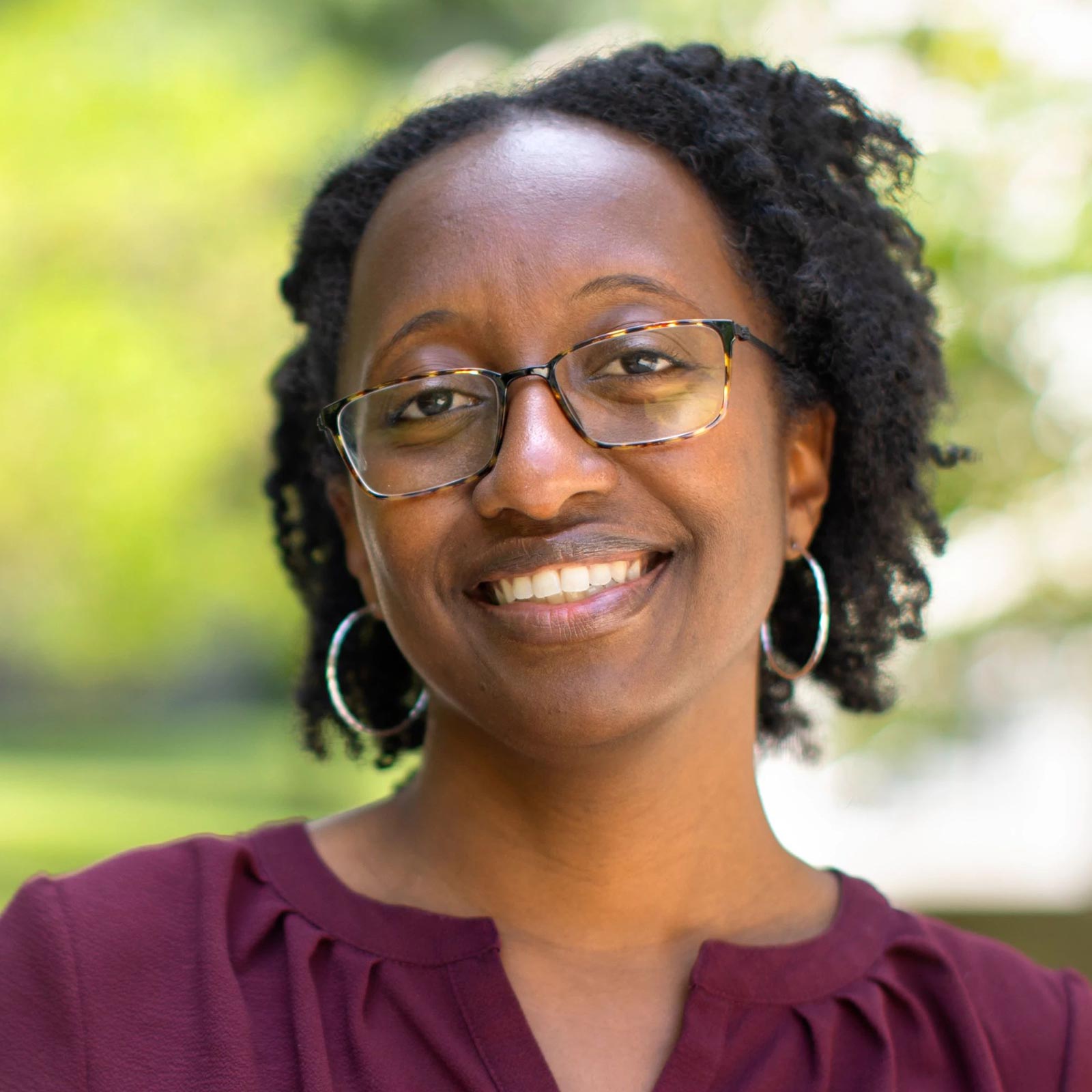
Jamila Michener
Jamila Michener, Professor of Government and Public Policy, is the inaugural director of the Center for Racial Justice and Equitable Futures.

Neil Lewis Jr.
Neil Lewis Jr, Associate Professor of Communication, Medicine, and Public Policy, is the inaugural associate director of the Center for Racial Justice and Equitable Futures.